
Reversed letters are a starting-point problem
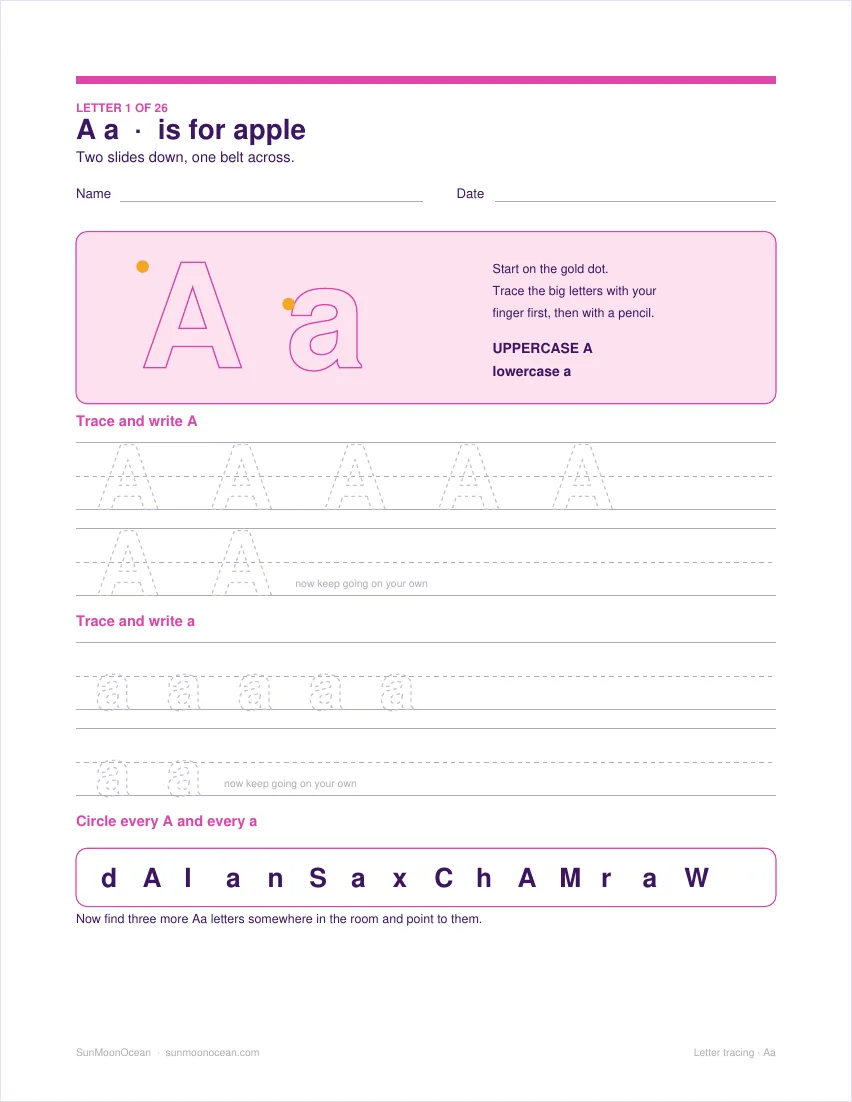
When a child writes a backwards b or N, the instinct is to correct the finished shape. It almost never works, because the shape is not the error — the pencil started in the wrong place and the rest followed. Every big letter on these pages carries a gold start dot, and the header gives the stroke in plain words (“down, then two bumps”). Fix where the pencil lands and the reversals tend to fix themselves.
The ruled rows are sized deliberately
Most free tracing sheets drop one font size into a fixed row, so capitals float in the middle and lowercase letters sit nowhere in particular. Here the capitals are sized so their tops meet the solid top rule, and the lowercase letters are sized so their x-height lands exactly on the dashed midline. That dashed line stops being decoration and starts being the instruction: lowercase letters stop here.
Trace, then keep going alone
Each case gets two rows. The first is fully traced. The second gives two traced letters and then leaves the rest of the line empty, which is the moment that actually matters — tracing is copying, and writing from memory is the skill. Below that is a circle-it strip mixing the target letter with look-alikes, because recognising a letter and drawing one are genuinely different jobs.
Start with her name
Not with A. Print the pages for the letters in her own name, in whatever order they come, and do those first. Nothing else motivates a three-year-old like writing her own name, and it gives every other letter a reason to exist. Fat pencils, crayons and a finger on the big letters all count: letter formation is a shoulder and elbow skill long before it is a finger skill.