
Why this one exists
Sight words are the words that break phonics. Said, come, where, two — sounding them out politely produces the wrong answer, so they have to be recognised on sight instead. That makes them a memory job, not a decoding job, and memory jobs need short, frequent, boring repetition rather than clever activities.
The part most sight word printables skip
Almost every free sight word sheet asks a child to trace the word and write it. That trains the hand and proves nothing about the eye. A child who has just traced came six times will read the very next word starting with c as “came” without hesitating. Every practice page here ends with a circle it line where the target word sits among near-misses that differ by exactly one letter — came, comc, come, com. She cannot get it right by looking at the first letter, which is the entire point.
How to actually use it
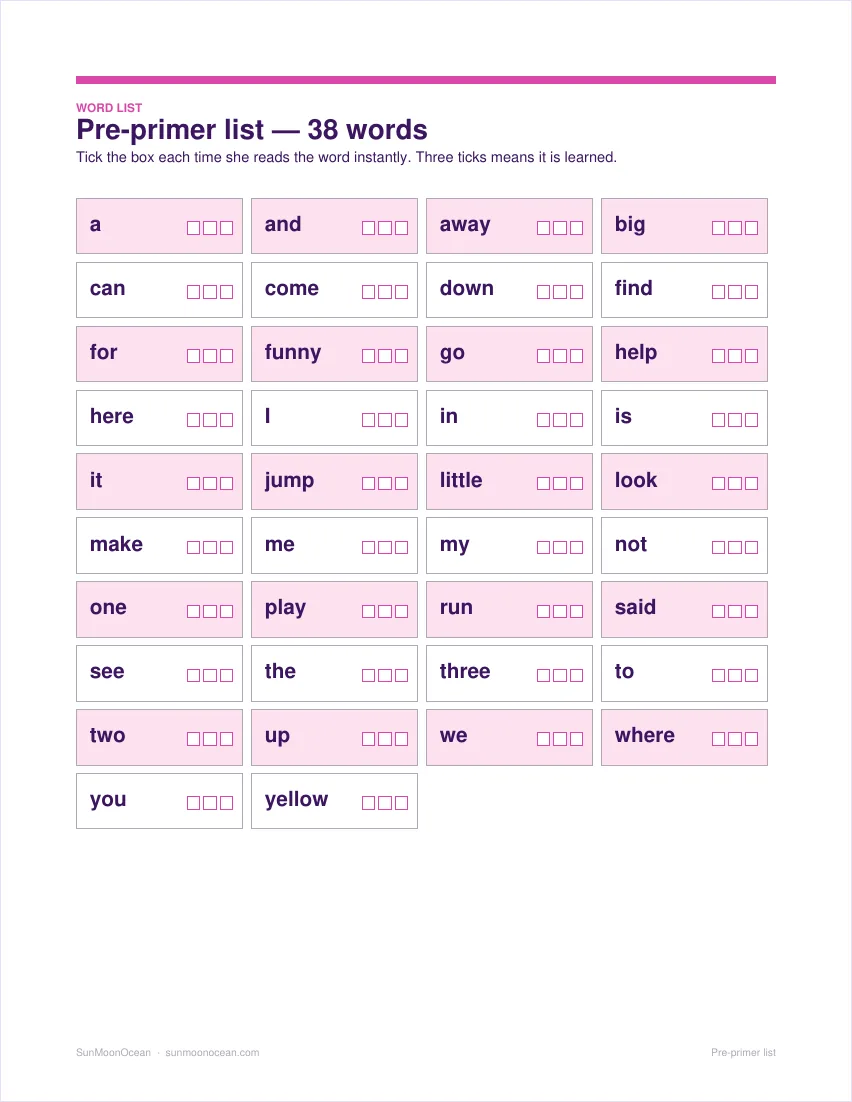
Sixty seconds on a list page, every day, is worth more than a twenty-minute session on a Sunday. Read across, left to right. Words she says instantly get a tick; three ticks means the word is learned and you stop practising it. Words she has to work out are the ones that go on the next practice page. Do not move on until five of the six words on a page come instantly — a wobbly sight word does not get firmer by meeting new ones.
What is inside
Page two is the pre-primer list (38 words) and page three the primer list (52 words), both with three tick boxes per word. Pages four to fifteen take six words at a time: a chip showing the word, one wide ruled row with a traced copy and room to write it twice, and the circle-it line underneath. Name and date at the top of every page, because these end up in a folder.