Slime Is Back: A Dad’s Safety and Cleanup Guide
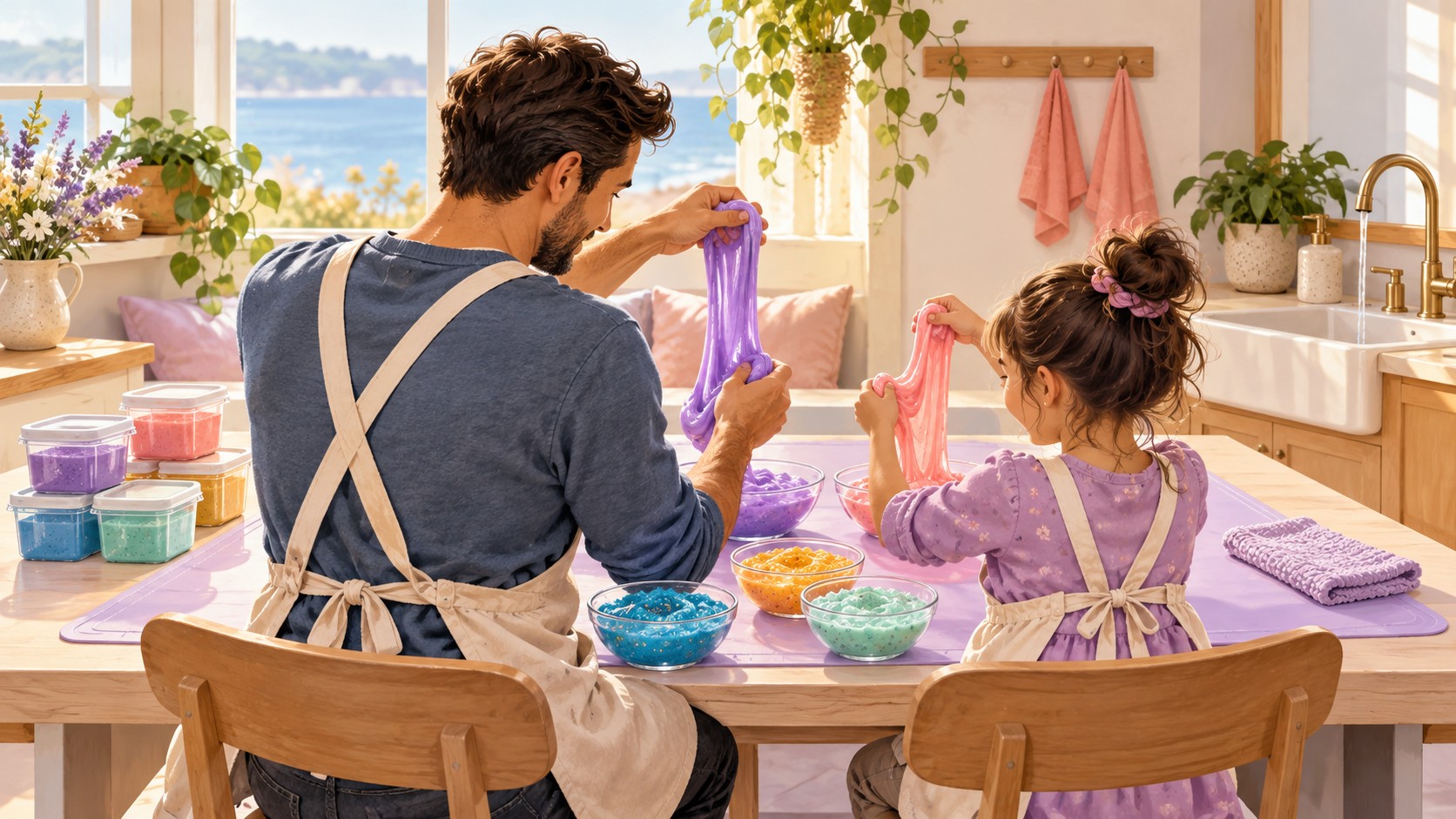
Slime never really disappeared. It just changed clothes. In 2026, the toy aisle is full of scented slime, butter textures, glossy mixes, surprise charms, beauty-inspired tools, and giant kits built for unboxing. Amazon placed the GUI GUI Mega Slime Haul in the sensory section of its 2026 Toys We Love list. The Toy Insider put the same kit on its Hot 20 list, and recent shopping coverage from Good Housekeeping and TODAY has pointed to slime, putty, and squishy textures as some of the year’s strongest hands-on trends.
The appeal is easy to understand. Slime is colorful, tactile, endlessly remixable, and more social than it looks. A child can knead quietly, compare textures, invent a pretend bakery, or hand Dad a mystery mixture and announce that he has thirty seconds to save it.
But the real parent question is not whether slime is viral. It is whether the product fits your child, your home, and the way you plan to supervise it. Slime can be good shared play without becoming a permanent carpet feature. The difference is a short buying check and a routine everyone knows before the lid comes off.
Why slime has found another gear
Today’s kits turn texture into a collection. One set may include cloud, clear, butter, jelly, or crunchy slime, plus charms and tools that let children change the look and feel. That variety gives the activity a beginning, middle, and reset: open one texture, notice what it does, make a small change, compare the result, then pack it away.
That is a useful play pattern. Unlike a one-joke electronic toy, slime does not dictate the story. It gives a child material to investigate. She can stretch it slowly, test whether a shape holds, sort colors, hide and recover a charm, or narrate a pretend recipe. Dad can join without needing to control the outcome.
The trend also overlaps with the larger 2026 appetite for sensory and squishy toys. The Toy Association has described growing interest in toys that offer creativity, comfort, and self-expression. Slime sits right in that lane—but “sensory” is not a safety guarantee. It is a description of the experience, not proof that every formula, accessory, or marketplace listing is suitable.
Store-bought slime and homemade slime are not the same decision
A commercial kit should carry a clear age grade, manufacturer identity, ingredients or safety information where required, warnings, and directions for use. A homemade recipe can vary widely depending on the glue, activator, detergent, fragrance, dye, or contact-lens solution used. That variation matters.
Poison Control notes that some slime recipes use borax or related borates. Depending on concentration and exposure, homemade slime can irritate skin or eyes, and swallowing it can cause gastrointestinal symptoms. Their practical advice is simple: supervise play, choose products labeled nontoxic, wash hands before and after, use a clean surface, keep slime away from mouths, and stop if redness, itching, or burning appears.
I would not treat a viral recipe as a chemistry shortcut. If your daughter wants to make slime from scratch, choose a child-appropriate recipe from a trustworthy source, use only the listed amounts, and keep household-strength borax, detergent, and other concentrated ingredients in adult hands. For many families, a reputable ready-made kit is the easier choice because the formula and instructions are already defined.
The safety line: know what is inside
“Squishy,” “putty,” and “slime” are often grouped together online, but they may be very different products. Slime is usually a loose or semi-solid compound stored in a tub. A squeeze toy may have an outer skin filled with gel, sand, foam, or water beads. Those differences affect the hazard if a product tears.
Recent CPSC actions show why the distinction matters. In August 2026, the agency warned about fake and counterfeit squishy toys and a social-media trend involving heating them. In October, CPSC announced a recall of certain squishy dumpling and crazy squib ball toys containing water beads that could pose an ingestion and intestinal-obstruction hazard. Earlier in 2026, some Orb Funkee squeeze toys were recalled because filling material could contain asbestos.
Those notices are not about every slime kit, and they are not a reason to confuse one category with another. They are a reason to buy the exact product you researched, avoid counterfeit listings, inspect containers and squeeze-toy skins, and never heat, freeze, cut open, or deliberately rupture sensory toys unless the manufacturer specifically designed and instructs that use.
My six-point buying check
1. Match the age label to the youngest child who can reach it
Small charms, decorative mix-ins, and miniature tools can create choking risks even when the slime itself is labeled nontoxic. If a toddler sibling visits the play area, store the entire kit where that child cannot access it.
2. Find the manufacturer before you fall for the color
Choose a listing that names the maker, shows the original packaging, provides warnings, and offers a real contact route. Avoid pages that mix brand names, reuse unrelated photos, or hide who produced the item.
3. Search the exact name in the CPSC recall database
Search by brand and model, not only “slime.” A recall may apply to one product line, date code, or filler material. Repeat the check for hand-me-down toys or anything stored for a long time.
4. Read the ingredient and allergy information
Fragrance, colorants, preservatives, and activators can matter for children with sensitive skin. “Nontoxic” does not mean “edible,” and it does not promise that no child will react. Follow the directions and stop play if irritation develops.
5. Count the cleanup system as part of the product
A sturdy resealable container is not boring packaging; it is what keeps the toy usable. Favor kits with separate tubs, clear instructions, and tools that return to one case. Fifty loose decorations are only fun if you have a plan for all fifty.
6. Ask whether the kit supports repeat play
The best kit is not necessarily the largest. Look for contrasting textures, colors that can be kept separate, and tools that create several kinds of play. If every component must be combined on day one, the activity may have one exciting afternoon and a short shelf life.
The SunMoonOcean slime station
Before opening anything, put down a silicone craft mat, plastic tray, or washable table covering. Move rugs, upholstered chairs, blankets, and treasured paper out of reach. Set a damp cloth and dry towel nearby. Tie back long hair and roll up sleeves. Then choose one or two tubs—not the whole kit.
Use one sentence as the house rule: Slime stays over the mat. That is easier to remember than a speech about every surface it should avoid. Dad follows the rule too.
When play ends, pick out reusable charms, return each texture to its own labeled container, wipe tools, close every lid, and wash hands with soap and water. Check the floor before leaving. Store the kit in a closed bin away from younger children and pets.
If slime reaches fabric, do not rub it deeper or reach automatically for hot water. Remove the excess gently and follow the clothing or furniture maker’s care guidance. Different slime formulas behave differently, so test any cleaner in a hidden area first.
Five ways to make slime play more than squeezing
The texture lab
Choose two slimes and describe them without saying their colors. Is one airy, stretchy, glossy, grainy, slow, or springy? Dad writes down her words. You are building observation and vocabulary without turning the activity into homework.
The stretch estimate
Place a ruler beside the mat. Guess how far a small piece will stretch before it separates, then test it slowly. Compare the guess with the result. Keep the amount small so the experiment stays controlled.
The hidden-charms story
Hide three large, age-appropriate charms in one tub. Each object she finds becomes the next part of a story. Dad adds one sentence; she adds the next. Return every charm to its storage cup when the story ends.
The color boundary challenge
Place two colors side by side and try to make a pattern without fully mixing them. This slows down the rush to combine everything and helps the kit last. If the colors do blend, name the new shade rather than treating it as a mistake.
The cleanup race against Dad
Not a frantic race—a cooperative one. Can both of you return every tool, close every tub, wipe the mat, and wash hands before a favorite two-minute song ends? The goal is to make cleanup part of the play loop, not the punishment afterward.
When I would skip the trend
I would skip slime for a child who still explores objects with her mouth, cannot follow the “over the mat” boundary, or has broken or irritated skin on her hands. I would pause if fragrance triggers headaches or if the ingredient information is unclear. I would also skip anonymous mega-bundles whose main selling point is quantity rather than traceable manufacturing and instructions.
And I would skip the pressure to buy because a video made the texture look irresistible. Start with one reputable tub or small kit. Watch what she actually enjoys: stretching, mixing, storytelling, sorting, or simply the quiet hand motion. Then buy toward that play pattern.
The SunMoonOcean take
Slime earns its place when it creates curiosity and time together—not when Dad spends the entire session guarding the sofa. Buy deliberately. Know whether you are choosing slime, putty, or a filled squeeze toy. Check recalls. Protect the surface. Keep hands clean. Let her lead one experiment, and make the reset routine as predictable as opening the lid.
For age-matched gift ideas, visit our gift guide for ages 6–8 or gift guide for ages 9–12. You can also compare our broader viral-toy guide and browse the current SunMoonOcean toy picks.