The Quiet Toy Trend of 2026: Craft Kits Kids Can Make Their Own
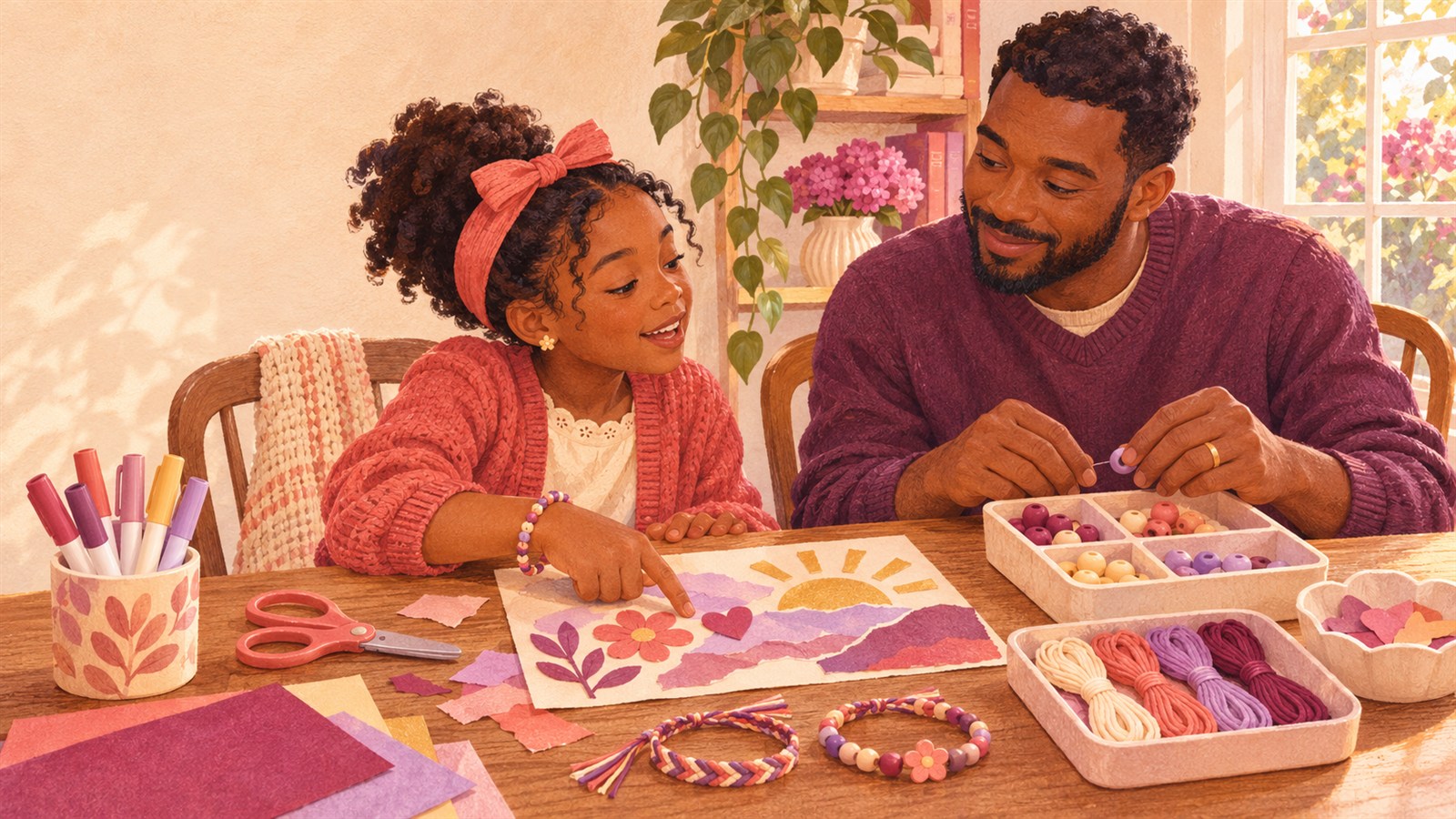
The loudest toy trends usually arrive with unboxing videos, scarcity, and a character your child met somewhere else. One of 2026’s strongest play patterns is moving in the opposite direction. Children and parents are returning to bracelet making, collage, beginner sewing, painting, paper craft, and small projects that keep hands busy without deciding every detail for them.
Spielwarenmesse, the major international toy fair, named this movement Creative Mindfulness: making as a conscious, calming kind of play. The Toy Association’s 2026 trend report likewise highlighted open-ended kits and design-led creative toys, while retailer data reported by Faire and The Toy Book showed friendship-bracelet kit searches up 65% quarter over quarter. Michaels reported an 86% year-over-year rise in guided craft-kit sales.
That is enough evidence to call this a real category shift, not a one-product spike. But a trending craft kit is not automatically a good one. Some offer a satisfying starting point and room to improvise. Others are a bag of tiny parts, one fragile sample photo, and an adult quietly finishing the project after bedtime.
The useful question is not “Which kit is viral?” It is: Can she begin it, change it, and feel that the result belongs to her?
Why creative making is landing now
Craft kits meet two needs at once. They reduce the friction of starting—materials are gathered, the basic sequence is visible—and still let a child make real choices. That balance matters. A blank page can feel intimidating. A project with only one acceptable result can feel like a test. A well-designed kit sits between those extremes.
The trend also fits a broader appetite for analog play. The latest Associated Press gift coverage describes growing interest in screen-free hobbies and “hobby in a box” projects. Faire’s 2026 retail reporting found craft-kit searches up 71% year over year. These are not identical audiences or measurements, but together they point in the same direction: people want tangible activities that reward attention instead of refreshing a feed.
For a girl dad, the value is not just the finished bracelet or collage. Making side by side gives conversation somewhere to rest. You can sort colors while she tells you about school. You can ask why she changed the pattern without interrogating her. Your hands are occupied, so eye contact is optional and the talk can arrive naturally.
The difference between a project and a performance
A good project gives enough structure to build confidence. A performance asks a child to reproduce the box exactly so an adult can admire it.
Look at the instructions. Do they teach one technique and then show variations? Or do they prescribe the color, placement, and final appearance of every piece? The first approach says, “Here is how this works.” The second can accidentally say, “Here is what success looks like.”
There is nothing wrong with following directions. Sequencing is a real part of making. The problem arrives when a kit markets creativity while leaving no meaningful decision to the child. The best kits offer a reliable first win, then open a door: another pattern, a different color story, a new character, or a useful object she invents herself.
My seven-point craft-kit check
1. Match the age grade to the youngest child who can reach it
Bracelet and jewelry kits often contain beads, charms, needles, clasps, or long cords. Follow the manufacturer’s age label and warnings. Think beyond the intended maker: a toddler sibling visiting the same table changes the storage plan. Small pieces go into a closed container before anyone leaves the room.
2. Check the material list, not just the finished photo
Look for a named manufacturer, clear contents, warnings, and a real contact route. Avoid anonymous kits whose photos and descriptions do not agree. Search the exact brand and model in the CPSC recall database before purchase, especially for marketplace listings and hand-me-downs.
3. Skip hidden hazards disguised as “sensory” extras
Water beads do not belong in a casual craft setup for young children. CPSC’s 2026 federal standard and safety guidance emphasize their ingestion and obstruction risks. Loose high-powered magnets and accessible button batteries also deserve a hard no. A craft kit does not need a dramatic surprise component to be interesting.
4. Choose tools she can control
For younger makers, favor blunt-tip scissors, washable markers, peel-and-stick pieces, larger beads, pre-cut cord, and water-based adhesives intended for children. Hot glue guns, craft knives, resin systems, and adult-strength chemicals turn a child-led project into an adult-controlled one and introduce risks the activity does not need.
5. Look for a short first session
The first satisfying result should be reachable before fatigue takes over. One small bracelet, a single stitched shape, or a postcard-size collage is enough. A kit that requires two hours of setup before the child makes a choice may be better saved for an older age band.
6. Count what can be used twice
Does the kit include a reusable loom, template, storage tray, punch, or instruction card? Can ordinary paper, thread, or cardboard refill it? The more the core tool works with everyday supplies, the less likely the activity becomes a one-afternoon package.
7. Ask whether there is room for a second idea
After the example is complete, what can she do differently? If the answer is “nothing; the materials are gone,” you are buying an experience. That can still be worthwhile. Just do not mistake it for open-ended play. A stronger kit leaves enough material, method, or imagination for another attempt.
How Dad can help without becoming the project manager
Before starting, set one boundary and one freedom. The boundary might be “beads stay over the tray.” The freedom might be “your pattern can change whenever you want.” That is easier to follow than a running stream of corrections.
Do the awkward first step together. Tie the starting knot, thread the needle if the age guidance permits, or show how much glue is enough. Then hand the tool back. Your job is to make the next step possible, not invisible.
Ask questions that return ownership: “Which part do you want to keep?” “What would make it more yours?” “Do you want help, company, or space?” The last question is especially useful. Children do not always need Dad to solve the problem; sometimes they want him nearby while they solve it.
Resist correcting harmless asymmetry. A crooked stitch can be proof that she made it. If a structural mistake will undo the whole project, explain the tradeoff once: “That knot may slip. Want to test it or tighten it?” She still gets a choice.
Four ways to extend one kit
The two-maker swap
Each person begins a small piece, works for five minutes, then swaps. The rule is that you must preserve one thing the other maker started. It turns cooperation into a visible design choice.
The story bracelet
Assign each color a moment: something funny, brave, kind, surprising, or worth remembering. Choose beads while telling the stories. The bracelet becomes a record without needing a perfect explanation.
The refill challenge
After the included materials run low, search the recycling bin and basic art supplies. Cardboard becomes a loom. Magazine paper becomes beads. A cereal box becomes a frame. The kit teaches the method; the house supplies the next version.
The useful gift
Make one small item for someone specific—a bookmark, card, bracelet, or decorated envelope. Let your daughter decide who receives it and why. The point is not forced generosity; it is seeing that her hands can make something meaningful.
When I would skip the kit
I would skip a set with unclear age labeling, anonymous manufacturing, conflicting contents, or reviews mentioning missing warnings and broken tools. I would skip kits dominated by tiny loose parts for a home with younger children unless storage and supervision are genuinely reliable.
I would also skip any product promising therapy, anxiety relief, intelligence gains, or developmental outcomes it cannot substantiate. Crafting can feel absorbing or peaceful, but a toy package should not make medical promises.
Finally, I would skip a beautiful kit if the adult secretly needs the result to be beautiful. Choose a cheaper, looser activity until everyone is ready to let the child’s version be the point.
The SunMoonOcean take
Creative mindfulness is a healthier kind of toy trend because it points toward a play pattern, not one must-have object. The winner is not the kit with the most pieces. It is the one that helps her begin, leaves her room to depart from the picture, and makes it easy for Dad to sit beside her without taking the work away.
Start small. Choose traceable materials and age-matched tools. Protect the table, contain the small parts, and let the ending stay open.
For more age-matched ideas, visit our gift guide for ages 6–8, gift guide for ages 9–12, or the broader viral-toy guide. Browse current recommendations on SunMoonOcean Picks.
Sources
- The Toy Association: 2026 toy and play trends
- Spielwarenmesse: Creative Mindfulness, a 2026 ToyTrend
- The Toy Book: 2026 retail trend data for bracelet and cross-stitch kits
- Michaels: 2026 Creativity Trend Report
- Associated Press: screen-free craft gifts and hobby kits
- U.S. Consumer Product Safety Commission recall database
- CPSC Water Beads Information Center