Pretend Grocery Store Play Is Back: 7 Market Games for Ages 3–6
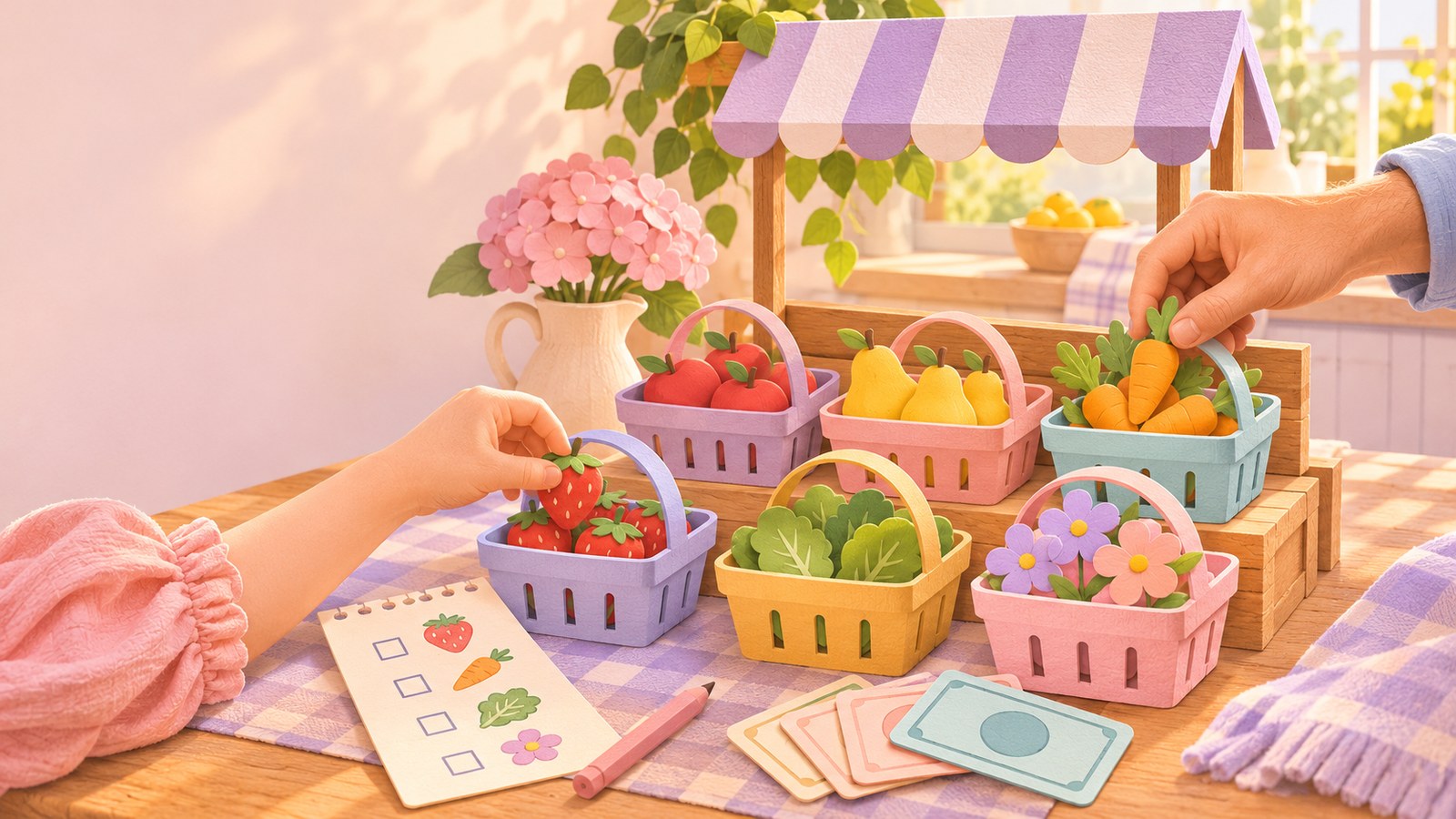
Miniatures are having a big year, but the part I care about is not the tiny packaging or the unboxing moment. It is what happens after the box is open. A small market can become a sorting game, a restaurant, a delivery route, a math problem, or a story where your daughter is in charge.
That flexibility is why miniature market play deserves a closer look. Industry trend reports in 2026 have highlighted small-world toys, real-life role play, and screen-free experiences. The Mini Farmstand Sorting Set also won Preschool Toy of the Year. Those signals do not mean every tiny toy is worth buying. They do suggest that a familiar play pattern—shopping, stocking, choosing, and pretending—is finding a fresh audience.
This guide is for ages 3–6 and focuses on what makes pretend grocery store play last. You do not need a branded set. A few baskets, safe pretend foods, paper order cards, and five minutes together are enough.
Why miniature market play is rising now
The Toy Association’s 2026 trend report points to families looking for low-tech play that feels creative, calming, and human. A separate industry trend report from MPL described rising interest in miniature toys based on everyday activities such as cooking and gardening. That matters because children already understand the basic script: someone stocks, someone shops, and someone decides what happens next.
The strongest market sets do more than copy a grocery shelf. They leave room for a child to change the rules. Today the basket is organized by color. Tomorrow the strawberries are medicine for a stuffed dragon. On Saturday Dad is the customer who keeps forgetting his list. The objects stay the same while the story grows.
That is also the line between repeat play and clutter. A toy earns shelf space when it supports more than one role, more than one challenge, and more than one ending.
Start with a safer, simpler setup
For children under 3, avoid sets with small pieces. For ages 3–6, follow the manufacturer’s age grade, supervise play, and count the pieces before and after if younger siblings are nearby. Check baskets, clips, and pretend food for cracks, sharp edges, loose magnets, or pieces small enough to become a choking hazard. Keep play money large and simple; ordinary paper cards work well.
Before buying, search the U.S. Consumer Product Safety Commission recall database for the exact product and manufacturer. I found no matching CPSC recall for the Learning Resources Mini Farmstand Sorting Set when I checked on November 24, 2026, but recall status can change. Recheck at the time of purchase and follow any safety notice.
Then keep the first setup small: three baskets, six to ten items, and one short mission. A crowded table can turn an invitation into a cleanup job before play even begins.
Seven pretend grocery store games
1. The color order
Best for: a quick start with ages 3–4.
You are the customer. Ask for “two red foods and one yellow food.” Let her choose what counts. If a strawberry looks pink to her, that is useful information, not a mistake. Swap roles after one order so she gets to make the rule.
Make it harder: add a size or shape clue: “one long orange thing and two round red things.”
2. One more basket
Best for: counting without a worksheet.
Put two items in one basket and ask her to build a basket with one more. Continue with three and four. Keep the numbers within the range she can count confidently. The goal is not speed; it is seeing the difference between groups.
Dad move: make an obvious, funny error and let her correct you. Being the expert is part of the fun.
3. Shopper and seller switch
Best for: role play and conversation.
Give each round a tiny beginning and ending. The shopper says hello, asks for two items, pays with one play card, and says goodbye. Then switch jobs. Children often become more talkative when the character—not the child—has something to say.
Make it fresh: become a sleepy shopper, a chef in a hurry, or a customer shopping for a picnic.
4. What disappeared?
Best for: a calm memory game.
Place four items on the counter. Let her study them, close her eyes, and remove one. She names what is missing, then runs the next round. If four is too easy, add one item at a time. If it becomes frustrating, go back down.
Quiet variation: instead of removing an item, move one to a different basket.
5. The tiny budget
Best for: ages 5–6 who enjoy numbers.
Give every item the same pretend cost: one card. Hand her three cards and ask what three things she wants to buy. There is no need to imitate real prices. Equal values keep the focus on counting and choosing.
Make it harder: price one special item at two cards and ask what combinations still fit the budget.
6. The silly recipe
Best for: storytelling.
Pick three foods and invent a dish: strawberry-carrot soup, flower tacos, or pear pancakes. Ask three questions: Who ordered it? Where will they eat it? What happens after the first bite? The market becomes a story engine without needing new pieces.
Save the story: draw the recipe on an index card and add it to tomorrow’s menu.
7. Closing-time reset
Best for: ending play without a battle.
Announce that the market closes in two minutes. One person collects produce; the other returns baskets and cards. When everything is stored, choose the first game for next time. Cleanup becomes the final role in the story instead of the thing that interrupts it.
Keep it light: stop while she still wants one more round. That gives the toy somewhere to go tomorrow.
How to make one set last longer
Rotate the challenge, not the toy. Put three game cards in an envelope and choose only one each session. Add household props gradually: a reusable bag, a notepad, a cardboard “open” sign, or a stuffed-animal customer. Avoid dumping every accessory onto the table at once.
Follow her story before adding your lesson. If she turns the produce stand into a pet hospital, let the carrots become medicine. You can still count, sort, write an order, or take turns inside the story she chose.
Finally, watch what she repeats. If she keeps sorting, add harder categories. If she keeps selling, introduce more characters. If she keeps inventing recipes, make a small menu book. Repeat play tells you where the value is.
A current pick that fits the pattern
The Learning Resources Mini Farmstand Sorting Set is the clearest current example of this category. The Toy Foundation listed it among the 2026 Preschool Toy of the Year finalists, and Learning Resources later announced it as the category winner. Its small produce, baskets, activity cards, and pretend market setup support several of the games above.
It is age-graded 3+ and includes small parts, so use adult supervision and keep it away from children under 3. We recommend it for the play pattern, not because an award guarantees it will fit every child.
See the Mini Farmstand pick Our picks page contains a clearly marked Amazon affiliate link. We may earn from qualifying purchases at no extra cost to you.
The better trend to follow
The useful part of the miniature trend is not “buy more tiny things.” It is “do more with a few good pieces.” A market works because children recognize it, can take the lead, and can change the problem every time they play.
Start with one basket and one order. Let her be the seller. Get the order wrong on purpose. Then come back tomorrow and try a new role.
Dad Strong.
For more age-matched ideas, see our gift guide for ages 3–5, explore current SunMoonOcean Picks, or practice simple money play with Make Change.
Sources
- The Toy Association: 2026 toy and play trends
- The Toy Foundation: 2026 Toy of the Year finalists
- Learning Resources: Mini Farmstand named 2026 Preschool Toy of the Year
- TDmonthly: 2026 award-winning toys roundup
- MPL: miniature and experiential toy trend report
- U.S. Consumer Product Safety Commission recall database